Earlier article about Beacon can be seen here.UPDATE: Beacon began flight service Tuesday this week for its new all-you-can-fly service. The company offers 18 flights daily between BOS Boston and HPN New York in King Air 200 turboprops carrying 6 passengers. Flight time is around 45 minutes. For $2,000 per month members can fly as much as they like, and have as many as 4 reserved flights (future boarding passes) at a time.
Beacon members walk to their flight September 15 on the first day of service
Dynamic Aviation, based in Virginia, is the Part-135 certified operator of Beacon's flights and is starting the service with three King Air 200 turboprops.
Beacon plans to add service to Washington D.C. within a year, and will offer seasonal service to Nantucket and the Hamptons beginning next summer. They plan to operate 27 aircraft eventually, with more destinations to be added.
Charter operator Landmark Aviation has completed the re-branding of TWC Aviation based in Van Nuys and San Jose, CA following the acquisition in April 2015 and is now operating under the Landmark name. TWC was founded in 1998 and most recently operated 29 jets of various makes and sizes. TWC's operating certificate remains intact and operations are now under the Landmark name.
Temporary Landmark signage is up at both California locations. TWC's office in White Plains, NY has been relocated to the Landmark facility at HPN, and the Scottsdale, AZ airport recently opened office is now closed.
Landmark Aviation's charter fleet now numbers 63, the fourth largest charter fleet behind Executive Jet Management with 100 aircraft for charter, Travel Management Company with 67 and Delta Private Jets with 65 aircraft.
Landmark's entire charter fleet is only available in FlightList PRO.
Landmark has been on a growth run the past two years, having acquired several operators including Galvin Flying Service in Seattle, WA, Sterling Aviation in Milwaukee, Midlantic Jet Charters in Atlantic City, and now TWC Aviation in California. These, in addition to Landmarks existing charter fleets in North Carolina and South Dakota.
Online charter booking engine Stratajet is set to roll out its service to private aviation consumers on September 28. The UK-based company, which claims to offer the only real-time online booking engine for charter flights, has established a database of up to 500 available aircraft for which its software will generate live pricing information.
In a project called Operation Long Reach, Stratajet spent April through August visiting 50 charter operators and FBOs in 30 cities across 14 European countries to promote its technology. The main aim was to persuade operators to link their operations software with the Stratajet system and so make aircraft available for direct booking by customers.
Participating operators are eligible to use the company’s Stratafleet software, which uses the Stratajet search engine to generate flight quotes and more efficiently sell their available capacity. Its also offers the StrataFBO software to allow FBOs to interface with the main website.
Stratajet is now setting up meetings with operators in the U.S., Middle East and Russia to expand its database of available aircraft. The company also has just appointed David Lee as its chief financial officer. Lee has more than a decade of experience in developing Internet businesses and was recently named by the Institute of Chartered Accountants as Finance Director of the Year.
The Stratajet team includes (left to right): Olivia Scarlett, head of marketing, Mike Gadd, head of operator and FBO relations, Cecilie Øya?s, co-pilot and operator and FBO liaison and Jonny Nicol, CEO.“Following an exhausting few months, flying around Europe in our Chieftain aircraft, it is very rewarding to be able to confirm that we have hit our targets in relation to the number and range of aircraft available on the Stratajet platform,” commented CEO Jonny Nicol. “The positive response we received throughout the campaign has proven what we knew all along: the industry needs technological development in order to grow. I think one of our greatest achievements is that we gained the understanding from the operators that other companies, claiming to do what Stratajet does, are simply not delivering.”
Stratajet has been in development for the past four years while Nicol and his team refined the algorithm that he says delivers the charter industry’s only 100-percent accurate, real-time charter booking system for consumers. Essentially, the system is intended to calculate the true cost of a so-called “partial empty leg” by working out the net difference in cost of the requested new trip and any empty leg involved.
“This means that the consumer pays less and the operator makes a greater profit margin,” Nicol told AIN. Stratajet employs a research team to ensure that the system includes up-to-date information on all relevant costs, such as airport landing and parking fees. Customers pay a 5 percent commission on the price of flights booked either online or by phone.
Article by Charles Alcock, courtesyAIN
Florida based charter brokerage, Airstream Jets, announced a new jet card concept with the launch of its Distance Card, with pricing based on distance flown rather than hours, according to a company press release.
“The Distance Card pricing model is revolutionary for its simplicity and flexibility. There is nothing else like it on the market. All other jet cards offer only the hour-based pricing model in some form or another. The level of flexibility and cost transparency the Distance Card provides is unprecedented” said Airstream Jets CEO, Pete Maestrales.
Each trip is billed according to distance traveled using a formula (Total Miles Flown x Price Per Mile = Total Cost) based on a tiered price per mile system where mileage rates decrease as travel distance increases. Customers may move between aircraft categories and choose the most appropriate aircraft size for their travel on a trip-by-trip basis.
Mileage rates start at $7 per mile for small jets and with packages starting at $25,000.
Source: press release
By Russ Niles, AVwebWheels Up Citation Excel XLS
The two pilots and five passengers aboard a chartered Wheels Up Citation Excel XLS had some anxious moments when the main cabin door opened in flight but didn't detach from the aircraft.
The aircraft had just taken off from San Francisco International Airport on Aug. 6 for a flight to Drummond Island Airport in Michigan and was climbing through 2,000 feet when the door opened.
The air traffic control dialogue (edited by YouTube channel VASAviation) reveals the open door prevented the business jet from climbing and the pilot needed both hands to maintain control of the aircraft as he declares an emergency and asks to return to the airport. "I gotta hold the aircraft. We cannot climb...," the pilot tells the controller as he asks for vectors and frequencies to make an instrument approach.
A short time later the aircraft came out of the clouds and the crew was able to make a visual approach. As the Citation turned base, a controller reported it only had one main landing gear but it turned out he mistook the hanging door for a gear leg. The gear worked normally and the crew made a safe landing on Runway 28R with emergency apparatus standing by.
The occupants evacuated the airplane on a taxiway. Wheels Up is a relatively new charter company that intends to build most of its business around a large fleet of King Airs but it started flying Citations in 2014.
courtesy Russ Niles & AVweb
Fred George and Business & Commercial Aviation just published an in-depth look at the new Cessna's Citation M2 from Textron Aviation. It's the third iteration of the CitationJet which debuted in 1992.
The M2 is luring considerably more buyers than some competitors for very compelling reasons noted below. With deliveries beginning in late 2013, including 60 aircraft last year and more than two dozen delivered to date in 2015, there are now more than 95 aircraft in the fleet.
That’s an impressive record for a low-risk, lean-budget derivative’s entry into what’s still a tepid market. Many times, clean-sheet designs get all the attention. With this aircraft, it was attention to detail that mattered.
Little has changed in the M2’s airframe compared to the original CitationJet. It retains the 58-in. inside diameter, circular cross-section fuselage of the original 1971 Citation 500, a semi-monocoque structure fabricated from conventional aluminum alloys, using rivets, fasteners and adhesive bonding. Composites are used to save weight in fairings, the nose radome and other non-load-bearing components.
What is important for charter customers?
The M2 is 22 kt. faster than the CJ1+ and 53 kt. faster than the Embraer Phenom 100E at FL 410, assuming standard-day temperatures and 9,000-lb. cruise weights. In August, Textron Aviation announced a boost in maximum takeoff field elevation to 14,000 ft. The M2’s more-powerful Williams FJ44 turbofans are the reason.
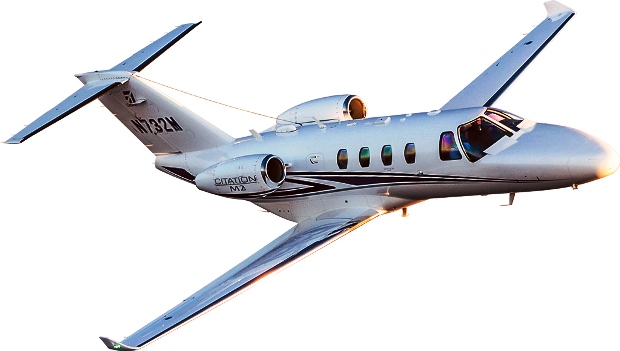
10 M2's are available for charter; 9 throughout the US and 1 in Germany. All are listed with operator and details in FlightList PRO.
The M2 seats 6 passengers, including a 4-place club, with a side-facing seat across from the entry door and a belted lavatory seat.
The cabin features an automatic pressurization controller that provides up to 8.5 psi of differential pressure, sufficient to maintain an 8,000-ft. cabin altitude at FL 410, the aircraft’s maximum cruise altitude. The DC-powered, vapor-cycle air conditioner may be operated anytime in flight or by the right generator or GPU on the ground. Thus, the cabin can be cooled on the ground prior to engine start. The interior has single-zone temperature control, but a five-position flow divider enables the crew to modulate the temperature of the cabin separately from the cockpit.
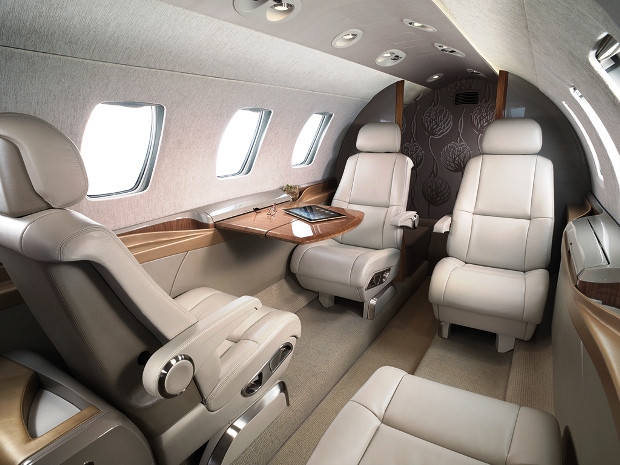
The M2’s cabin cross-section is smaller than those of some entry-level jets and the floor is narrower. But the interior has been completely redesigned to make it more functional, comfortable and space efficient. The cabin window reveals, for instance, have been flattened to allow more ambient light to flood the interior from the 11-in.-wide by 15-in.-tall transparencies. The seats have retractable inboard armrests to provide easier passage through the aisle. The four club chairs have tilt, swivel, lateral and fore/aft track adjustments. Left- and right-side, foldout worktables may be extended between pairs of facing club chairs. There are left- and right-side 110-volt AC power outlets, below the worktable pockets in the sidewalls.
There also are USB charging ports and audio jacks. Each passenger seat has an air outlet, LED reading light and oxygen mask in the overhead.
Main cabin has four club chairs with standard swivel, track, recline and fore/aft adjustments. Furnishings are top notch. Standard is a belted potty and forward side-facing seats.
Unable to measure interior sound levels at cruise, subjectively the M2 appears to have one of the quietest cabins in the entry-level turbine aircraft class. Notably, interior fit and finish, including cabinetry, tables, sidewalls and leathers, are top notch, befitting a $4.5 million business aircraft. In our opinion, interior quality is unmatched in this class of aircraft.
The M2’s cabin dimensions, window size and baggage capacity quite clearly are smaller than those of some competitors. But its longest missions won’t exceed 3+00 to 3+30 duration, so those shortcomings are less important than they would be in an aircraft with more range.
Two external baggage compartments have a combined 43.1-cu.-ft. capacity, one-quarter less than some competitors. But the forward 12.7-cu.-ft. compartment in the nose has a 400-lb. capacity and the aft 30.2-ft. compartment, available with an optional ski tube, has a 325-lb. capacity. In contrast, the Phenom 100E has a 7-cu.-ft. forward baggage compartment and a 53-cu.-ft. aft baggage compartment.
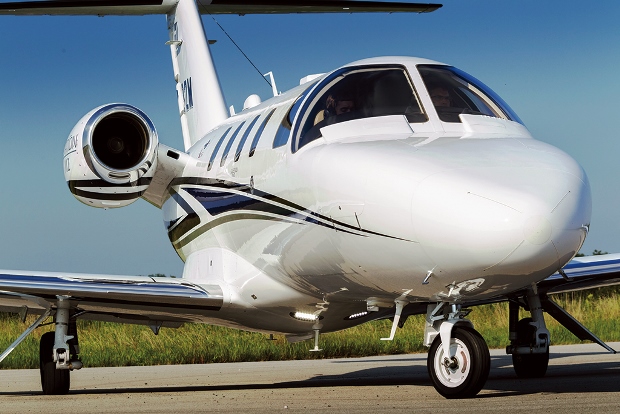
Cessna Citation M2 light jet. Nine are currently available for charter in the US.
The M2 isn’t the largest aircraft in the entry-level turbine aircraft market, but it’s unsurpassed for speed, safety and single-pilot ease of operations, in our opinion. It will cruise at 380 to 390 KTAS at typical jet altitudes. With typical options and at high-speed cruise, it will fly one pilot and four passengers 1,150 nm in 2 hr., 49 min., assuming standard day conditions. It will climb directly to FL 410, its maximum cruise altitude, in 24 min. That’s 27% faster than its closest competitor.
Read the full article from Business & Commercial Aviation at aviationweek.com here -
Private Jet Services (PJS), a worldwide aviation consulting firm, has been named one of the nation's fastest growing companies on the Inc. 5000 list for 2015, according to a release by the company.
PJS, now in it's 12th year, achieved 136% overall revenue growth over the recent 3-year period 2012-2014, and ranks #2,688 of 5,000 on this year's list. A repeat appearance, PJS achieved #2,410 on the 2014 list.
“It is an honor to be recognized among the fastest-growing companies in the country. This type of recognition really validates our success in meeting the evolving aviation needs of our expanding client base,” said PJS Founder and CEO Greg Raiff in the statement. “To have appeared two years in a row speaks volumes about our exceptional repeat client rate.”
Based in Seabrook, NH, Private Jet Services Group clients include Fortune 500 companies, professional sports teams, collegiate sports teams, the world’s biggest bands, private fliers and government workers. PJS offers fully tailored, on-demand aviation solutions to its clients. Founded in 2003 by Greg Raiff, PJS procures on behalf of those clients both VIP and standard configured airliners, regional aircraft, as well as light, midsize, and large cabin executive jets.
The Aspen-Pitkin County Airport is backing away from its plans to add a second FBO (fixed base operator) to the field. Pitkin County announced yesterday it is proceeding with part of the airport's planned upgrades, and one "environmental assessment" (EA) process laying out plans for a wider reconfigured runway to accommodate jets with wider wingspans, and a new terminal building. The county will forego a second EA and the plans to add a second FBO and taxiway for private planes on the airport's west side.
Currently Aspen airport has one FBO, operated by the Atlantic Aviation chain. During peak summer and winter holiday seasons Aspen is one of the busier single-runway, single-FBO airports in the country. In addition Aspen valley and its surrounding topography requires most jets to land and take off using the same approach/departure corridor to the east of the airport, requiring more planning and time needed to coordinate inbound and outbound aircraft.
Aspen's airport, from the mountains to the southwest.
Pitkin County was previously planning to put two EAs forward at once containing all elements of the master plan. But after meeting with with Federal Aviation Administration (FAA) officials over the last few months, it has decided to simplify the EA process to focus on upgrades to the airport’s east side, making it less confusing and more cost-effective, according to a Pitkin County press release.
“Safety has always been the top priority at this airport. We will be reconfiguring the runway to meet FAA design standards to accommodate aircraft with wider wingspans that will replace the commercial fleet serving Aspen in the coming years,” noted airport director John Kinney in the statement. “We also need a new terminal to address existing safety and functional issues and to better serve the traveling public.”
Private jets at Aspen airport. (photo courtesy of Aspen Times)
FAA funding that would contribute to both projects was delayed. Peacock said that FAA funding for the project wouldn’t be available on the timeline the airport had initially anticipated, necessitating a new plan for moving forward. The FAA funding availability had decreased because of demand from other airports around the nation, the statement noted.
The second FBO and west side taxiway still could be relaunched at a future date under a different EA process, but it’s dependent on funding, the statement added.
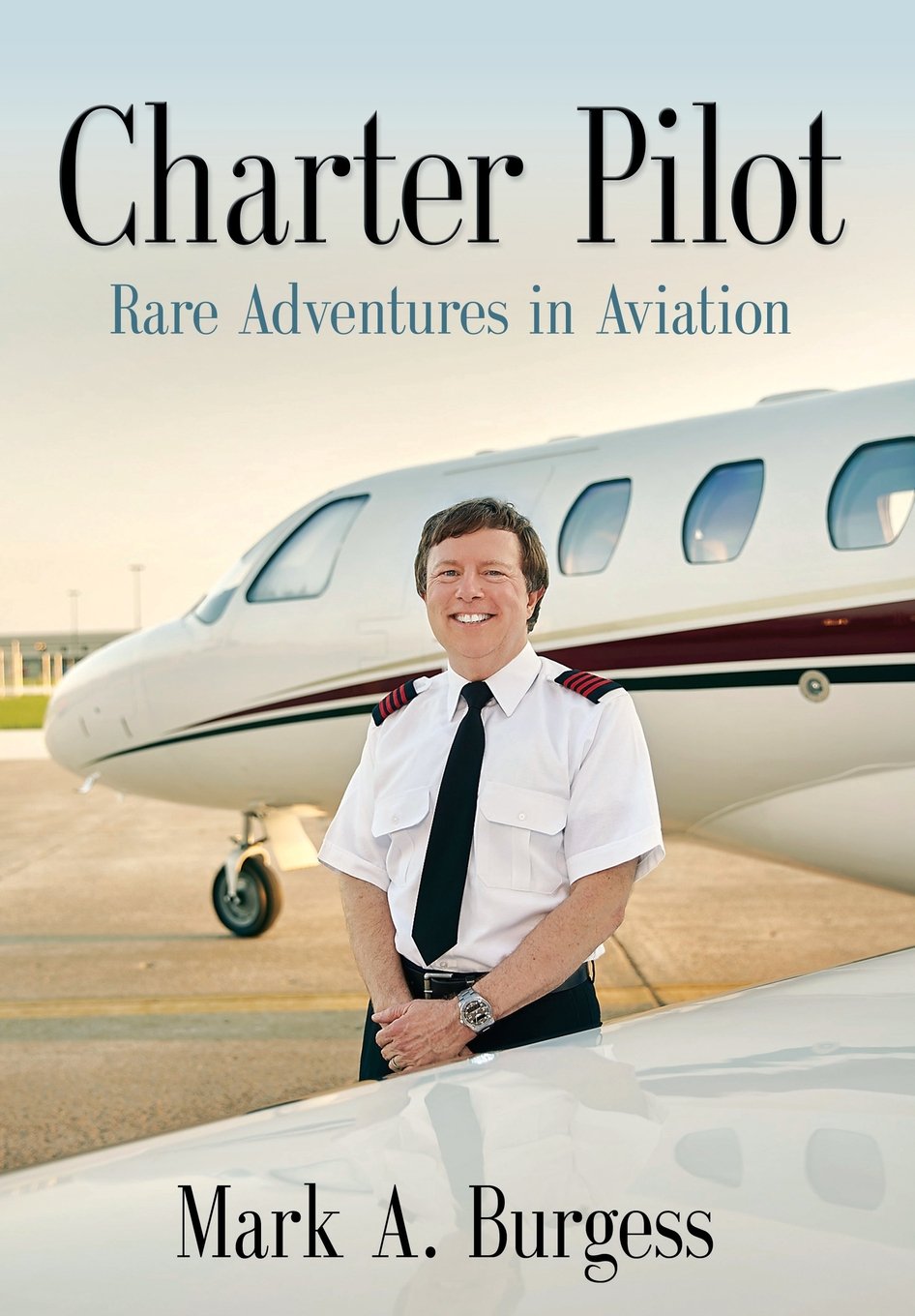
Available on Amazon
Anyone interested in general aviation, its history, and the funny and sometimes-scary adventures of a professional pilot will enjoy Mark Burgess' stories.
With wry humor, he takes us on his journey from an airplane-happy small-town youth, to certified 17-year-old pilot, to instructor and inspector of other pilots.
He has flown donated organs, fire patrol, and the rich and famous, and today is a successful entrepreneur with a rapidly growing company employing nine pilots.
Charter Pilot; Rare Adventures in Aviation is available on Amazon.
Article by Thomas McFarland, KSMU Ozarks Public Radio:
Decades of flight experience throughout southwest Missouri and beyond are on display in a new book by Mark Burgess. The local pilot and businessman recently released his auto-biography “Charter Pilot: Rare Adventures in Aviation,” which discusses an industry that rarely finds itself in the spotlight.
“Well the main purpose is to kind of introduce people to what this is. It’s an area of aviation many don’t understand,” says Burgess.
That area of aviation includes numerous flight jobs such as fire and pipeline patrol, instructor flight, and charter flight. Burgess discusses having flown everything from car parts to donated human organs, getting there via a non-traditional path. The usual gateway into the industry is through the military and major airlines, he says.
“But when I was coming out of high school we were coming out of Vietnam, so politically we didn’t need pilots. They didn’t want anybody, wouldn’t let anybody in, unless you had a college degree, perfect vision, all sort of things. You couldn’t go down the military track,” Burgess says.
So he took the private route, one he says many don’t know exists, and earned his license before the age of 18. From there he began instructing other pilots, including some who were new to the industry in the late 1970s.
“Probably one of the first female students that was back in the day that females weren’t flying that much. It was pretty odd to have female students, and I was barely 18 years old, and we had four or five instructors, and I ended up with the female student. She was a good student, she went out and learned it all quick. Her parents owned a 206, which is a pretty beefy single engine airplane. And it was just breaking new ground with her,” says Burgess.
Burgess is now the chief operating officer of Ozair, a Springfield-based charter service that offers cross-country and international flights. And it’s no accident the business is located in the Ozarks.
“Were so centrally located that if you call up and need me I can be on either coast in about three hours. Where if I was New York based I would be no market for California, and if I was California based I would be no market for Miami. But being here in the middle of the US we’re market for everybody, so we’ve got a pretty good range,” Burgess says.
So what is the best way to become a pilot? Burgess says the military is still the best option.
“If you can do the military routine and do the military life for a while, that’s obviously the place you want to go. You can get the most expensive training and the best equipment out there. And they’re going to pay you to do it, and it’s not going to come out of your pocket.”
If you’re interested in entering the field of aviation, or if you would just like to read the stories of a pilot in the Ozarks, you can find Mark Burgess’ book “Charter Pilot: Rare Adventures in Aviation” on Amazon.
Air Charter Industry Intelligence and Marketing Solutions:
Leading air charter brokers and travel professionals use FlightList PRO’s full-market resources, economical rates and marketing opportunities to grow their service level, their business and their bottom line.
Air Charter Broker Directory:
Free Charter Broker Directory used by private jet fliers. The largest listing of charter brokers for the U.S., Europe and worldwide. A free resource with charter broker details, ratings, accreditations, specialties and more. Go to the Air Charter Broker Directory.
Professional Aircraft Sourcing Platform:
Just $99/month-to-month. Request a free trial.
All 16,402 aircraft and 3,622 operators worldwide.
All 511 floating fleet aircraft from 48 operators.
FlightList PRO VERIFIED Economical, Professional and Independent Business Accreditation for Air Charter Brokerages. In the crowded airspace of air charter brokers, stand out to potential clients and industry partners as FlightList PRO VERIFIED, accredited as a reputable and experienced air charter service company. See more information here.
 UPDATE: Beacon began flight service Tuesday this week for its new all-you-can-fly service. The company offers 18 flights daily between BOS Boston and HPN New York in King Air 200 turboprops carrying 6 passengers. Flight time is around 45 minutes. For $2,000 per month members can fly as much as they like, and have as many as 4 reserved flights (future boarding passes) at a time.

 Charter operator Landmark Aviation has completed the re-branding of TWC Aviation based in Van Nuys and San Jose, CA following the acquisition in April 2015 and is now operating under the Landmark name. TWC was founded in 1998 and most recently operated 29 jets of various makes and sizes. TWC's operating certificate remains intact and operations are now under the Landmark name.
Temporary Landmark signage is up at both California locations. TWC's office in White Plains, NY has been relocated to the Landmark facility at HPN, and the Scottsdale, AZ airport recently opened office is now closed.
Landmark Aviation's charter fleet now numbers 63, the fourth largest charter fleet behind Executive Jet Management with 100 aircraft for charter, Travel Management Company with 67 and Delta Private Jets with 65 aircraft.
Charter operator Landmark Aviation has completed the re-branding of TWC Aviation based in Van Nuys and San Jose, CA following the acquisition in April 2015 and is now operating under the Landmark name. TWC was founded in 1998 and most recently operated 29 jets of various makes and sizes. TWC's operating certificate remains intact and operations are now under the Landmark name.
Temporary Landmark signage is up at both California locations. TWC's office in White Plains, NY has been relocated to the Landmark facility at HPN, and the Scottsdale, AZ airport recently opened office is now closed.
Landmark Aviation's charter fleet now numbers 63, the fourth largest charter fleet behind Executive Jet Management with 100 aircraft for charter, Travel Management Company with 67 and Delta Private Jets with 65 aircraft.
 Online charter booking engine Stratajet is set to roll out its service to private aviation consumers on September 28. The UK-based company, which claims to offer the only real-time online booking engine for charter flights, has established a database of up to 500 available aircraft for which its software will generate live pricing information.
In a project called Operation Long Reach, Stratajet spent April through August visiting 50 charter operators and FBOs in 30 cities across 14 European countries to promote its technology. The main aim was to persuade operators to link their operations software with the Stratajet system and so make aircraft available for direct booking by customers.
Participating operators are eligible to use the company’s Stratafleet software, which uses the Stratajet search engine to generate flight quotes and more efficiently sell their available capacity. Its also offers the StrataFBO software to allow FBOs to interface with the main website.
Stratajet is now setting up meetings with operators in the U.S., Middle East and Russia to expand its database of available aircraft. The company also has just appointed David Lee as its chief financial officer. Lee has more than a decade of experience in developing Internet businesses and was recently named by the Institute of Chartered Accountants as Finance Director of the Year.
Online charter booking engine Stratajet is set to roll out its service to private aviation consumers on September 28. The UK-based company, which claims to offer the only real-time online booking engine for charter flights, has established a database of up to 500 available aircraft for which its software will generate live pricing information.
In a project called Operation Long Reach, Stratajet spent April through August visiting 50 charter operators and FBOs in 30 cities across 14 European countries to promote its technology. The main aim was to persuade operators to link their operations software with the Stratajet system and so make aircraft available for direct booking by customers.
Participating operators are eligible to use the company’s Stratafleet software, which uses the Stratajet search engine to generate flight quotes and more efficiently sell their available capacity. Its also offers the StrataFBO software to allow FBOs to interface with the main website.
Stratajet is now setting up meetings with operators in the U.S., Middle East and Russia to expand its database of available aircraft. The company also has just appointed David Lee as its chief financial officer. Lee has more than a decade of experience in developing Internet businesses and was recently named by the Institute of Chartered Accountants as Finance Director of the Year.

 Florida based charter brokerage, Airstream Jets, announced a new jet card concept with the launch of its Distance Card, with pricing based on distance flown rather than hours, according to a company press release.
“The Distance Card pricing model is revolutionary for its simplicity and flexibility. There is nothing else like it on the market. All other jet cards offer only the hour-based pricing model in some form or another. The level of flexibility and cost transparency the Distance Card provides is unprecedented” said Airstream Jets CEO, Pete Maestrales.
Each trip is billed according to distance traveled using a formula (Total Miles Flown x Price Per Mile = Total Cost) based on a tiered price per mile system where mileage rates decrease as travel distance increases. Customers may move between aircraft categories and choose the most appropriate aircraft size for their travel on a trip-by-trip basis.
Mileage rates start at $7 per mile for small jets and with packages starting at $25,000.
Source: press release
Florida based charter brokerage, Airstream Jets, announced a new jet card concept with the launch of its Distance Card, with pricing based on distance flown rather than hours, according to a company press release.
“The Distance Card pricing model is revolutionary for its simplicity and flexibility. There is nothing else like it on the market. All other jet cards offer only the hour-based pricing model in some form or another. The level of flexibility and cost transparency the Distance Card provides is unprecedented” said Airstream Jets CEO, Pete Maestrales.
Each trip is billed according to distance traveled using a formula (Total Miles Flown x Price Per Mile = Total Cost) based on a tiered price per mile system where mileage rates decrease as travel distance increases. Customers may move between aircraft categories and choose the most appropriate aircraft size for their travel on a trip-by-trip basis.
Mileage rates start at $7 per mile for small jets and with packages starting at $25,000.
Source: press release

 Private Jet Services (PJS), a worldwide aviation consulting firm, has been named one of the nation's fastest growing companies on the Inc. 5000 list for 2015, according to a release by the company.
PJS, now in it's 12th year, achieved 136% overall revenue growth over the recent 3-year period 2012-2014, and ranks #2,688 of 5,000 on this year's list. A repeat appearance, PJS achieved #2,410 on the 2014 list.
Private Jet Services (PJS), a worldwide aviation consulting firm, has been named one of the nation's fastest growing companies on the Inc. 5000 list for 2015, according to a release by the company.
PJS, now in it's 12th year, achieved 136% overall revenue growth over the recent 3-year period 2012-2014, and ranks #2,688 of 5,000 on this year's list. A repeat appearance, PJS achieved #2,410 on the 2014 list.
 “It is an honor to be recognized among the fastest-growing companies in the country. This type of recognition really validates our success in meeting the evolving aviation needs of our expanding client base,” said PJS Founder and CEO Greg Raiff in the statement. “To have appeared two years in a row speaks volumes about our exceptional repeat client rate.”
Based in Seabrook, NH, Private Jet Services Group clients include Fortune 500 companies, professional sports teams, collegiate sports teams, the world’s biggest bands, private fliers and government workers. PJS offers fully tailored, on-demand aviation solutions to its clients. Founded in 2003 by Greg Raiff, PJS procures on behalf of those clients both VIP and standard configured airliners, regional aircraft, as well as light, midsize, and large cabin executive jets.
“It is an honor to be recognized among the fastest-growing companies in the country. This type of recognition really validates our success in meeting the evolving aviation needs of our expanding client base,” said PJS Founder and CEO Greg Raiff in the statement. “To have appeared two years in a row speaks volumes about our exceptional repeat client rate.”
Based in Seabrook, NH, Private Jet Services Group clients include Fortune 500 companies, professional sports teams, collegiate sports teams, the world’s biggest bands, private fliers and government workers. PJS offers fully tailored, on-demand aviation solutions to its clients. Founded in 2003 by Greg Raiff, PJS procures on behalf of those clients both VIP and standard configured airliners, regional aircraft, as well as light, midsize, and large cabin executive jets.
 The Aspen-Pitkin County Airport is backing away from its plans to add a second FBO (fixed base operator) to the field. Pitkin County announced yesterday it is proceeding with part of the airport's planned upgrades, and one "environmental assessment" (EA) process laying out plans for a wider reconfigured runway to accommodate jets with wider wingspans, and a new terminal building. The county will forego a second EA and the plans to add a second FBO and taxiway for private planes on the airport's west side.
Currently Aspen airport has one FBO, operated by the Atlantic Aviation chain. During peak summer and winter holiday seasons Aspen is one of the busier single-runway, single-FBO airports in the country. In addition Aspen valley and its surrounding topography requires most jets to land and take off using the same approach/departure corridor to the east of the airport, requiring more planning and time needed to coordinate inbound and outbound aircraft.
The Aspen-Pitkin County Airport is backing away from its plans to add a second FBO (fixed base operator) to the field. Pitkin County announced yesterday it is proceeding with part of the airport's planned upgrades, and one "environmental assessment" (EA) process laying out plans for a wider reconfigured runway to accommodate jets with wider wingspans, and a new terminal building. The county will forego a second EA and the plans to add a second FBO and taxiway for private planes on the airport's west side.
Currently Aspen airport has one FBO, operated by the Atlantic Aviation chain. During peak summer and winter holiday seasons Aspen is one of the busier single-runway, single-FBO airports in the country. In addition Aspen valley and its surrounding topography requires most jets to land and take off using the same approach/departure corridor to the east of the airport, requiring more planning and time needed to coordinate inbound and outbound aircraft.